
婉君
免费AI编程助手横评:2026年站长写代码,不花一分钱也能很高效_我的网站

A |
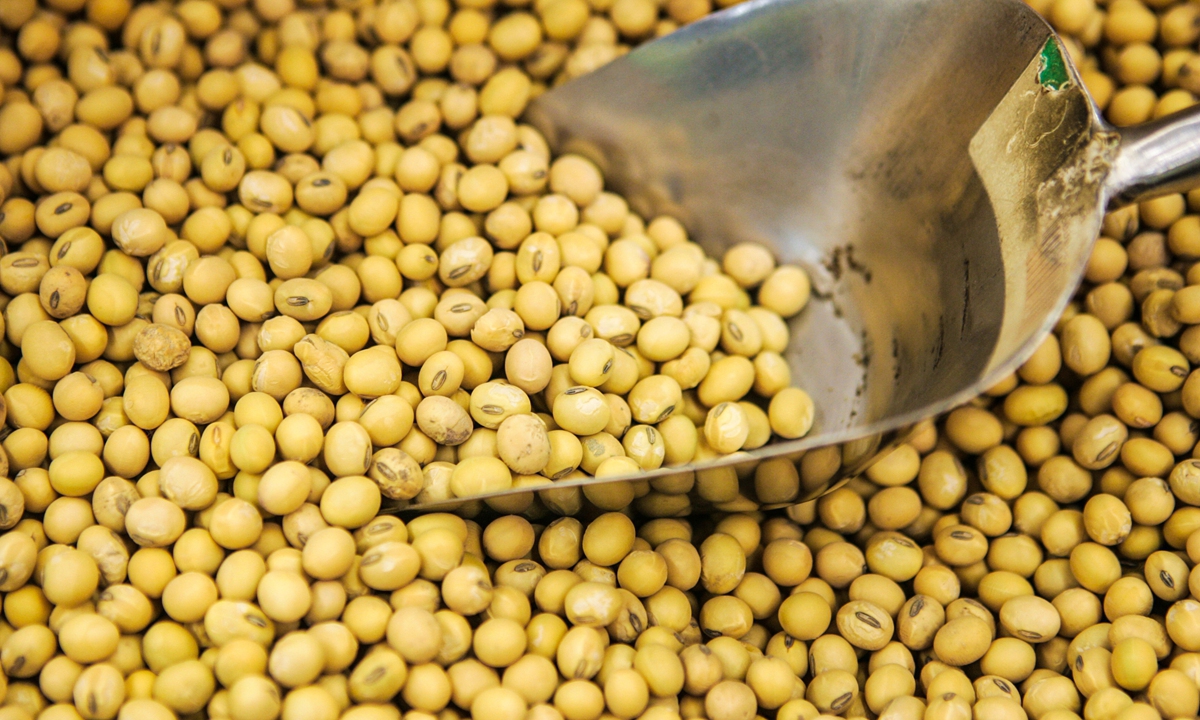
China continues to be the leading destination for Brazilian soybeans, and the Brazilian soybean industry wants to further deepen this relationship, expecting historically high volumes in the coming months, the Brazilian Association of Soybean Growers (Aprosoja Brasil) told the Global Times on Friday.
Brazilian soybean exports to China have remained very strong. China imported 12.08 million tons of soybeans from Brazil in June, up 13.7 percent year-on-year, while imports from the US fell 20.9 percent year-on-year to 1.27 million tons, according to data from the General Administration of Customs.
China imported 34.75 million tons of soybeans from Brazil during the period, up 9.1 percent year-on-year, according to Aprosoja Brasil. "Based on arrivals and customs clearance in China, there was clear growth," the association said.
According to the official data platform Brazilian Comex Stat, which records shipments at origin, 48.32 million metric tons were destined for China from January through June, largely unchanged from 48.41 million metric tons during the same period in 2025.
The difference between the two datasets mainly reflects timing and methodological differences between the recording of departures, cargoes in transit, arrivals and customs clearance.
Aprosoja Brasil said that the broader economic conclusion is the same: "Trade flows remained historically strong, China continued to be the leading destination for Brazilian soybeans, and Brazil's total soybean exports reached a first-half record of 69.57 million metric tons."
For farmers, strong export volumes help support the marketing of the crop, although record exports do not automatically mean record farm margins, said the Brazilian industry association.
China is the world's largest soybean importer. Imported soybeans are mainly used for oil production and animal feed. In terms of trading partners, China mainly imports soybean-related products from Brazil, the US, Argentina, Uruguay and Canada.
Brazil ranks among the world's leading soybean producers and exporters, with China being its largest export market for soybeans, according to the Xinhua News Agency.
Commenting on the significance of the Chinese market, Aprosoja Brasil said "China is absolutely strategic to Brazil's soybean industry," citing data showing that in 2025, China purchased 85.4 million metric tons, representing approximately 79 percent of all Brazilian soybean exports.
The two countries also have a highly complementary trade relationship. For Brazilian farmers, Chinese demand provides scale, market liquidity and greater capacity for long-term planning, said the Brazilian soybean industry association. For China, Brazil offers large, competitive and reliable supplies, as well as a crop calendar that complements production in other supplying countries.
Previously, policy shifts, such as US unilateral tariff measures, have caused disruption for US soybean farmers and other agricultural producers, Lü Xiang, research fellow at the Chinese Academy of Social Sciences, told the Global Times.
At the same time, China has been diversifying imports, including from Brazil and Argentina, to reduce risks from trade uncertainty, according to Lü.
Aprosoja Brasil noted that this partnership should not be seen merely as a temporary consequence of trade disputes involving third countries. Instead, it is a structural and mutually beneficial relationship, based on the complementarity between Brazil's production capacity and China's large demand for food, animal feed and protein, the industry group said.
Looking ahead to the soybean trade for the rest of the year, Aprosoja Brasil said that they are positive, while having a prudent mindset. Brazil has completed the harvest of a record soybean crop of approximately 180.6 million metric tons, and Brazilian soybean exports are expected to reach 116.3 million metric tons in 2026, which would also be a record, the association said.
"Brazil therefore has sufficient supply to continue serving the Chinese market strongly in the coming months... We expect historically high volumes, although not necessarily growth every single month, because soybean trade is seasonal and Northern Hemisphere supplies become more prominent during the second half of the year," it said.
。

B |
一键部署OpenClaw 站长多少都要会点代码——修改主题、调试插件、写点小功能。

C | 2026年,免费AI编程助手已经能覆盖从代码补全到全栈开发的完整需求。 TRAE SOLO:字节跳动的免费杀手锏 在Claude Code和Cursor以付费模式占据头部的情况下,字节跳动旗下TRAE SOLO以“完全免费”的姿态入局。功能对标付费产品,迅速在国内开发者社区掀起巨大声量。

D | 完全免费,无使用限制。适合预算有限但需要专业级编程辅助的站长和开发者。 Qwen Code:开源免费,每日2000次请求 开源、免费的AI编程助手,由Qwen3-Coder模型驱动。通过Qwen OAuth登录即可享受每日2000次免费请求额度。开源意味着技术型站长可以自行部署和定制。适合日常开发中高频使用AI编程辅助的开发者。 Goose:本地运行,隐私优先 金融科技公司Block开发的开源AI代理。提供与Claude Code几乎相同的功能,但完全运行在本地机器上,无需订阅费。数据不上云,隐私完全可控。适合对代码隐私有严格要求的技术型站长。

E | 腾讯云CodeBuddy:企业级AI编程助手 以腾讯混元+DeepSeek大模型为底座的AI辅助编程工具。深度集成至CloudStudio Web IDE,覆盖200+编程语言及框架。最新发布的CodeBuddy NPC能自动拉取代码仓库、理解上下文、制定方案、编写代码、提交PR,CI失败时还能自主读取日志、定位问题、迭代修复。免费版功能已足够个人站长使用。

F | 适合需要系统化代码辅助的站长。 美团NoCode:自然语言生成前端应用 2026年3月进入公开灰测。初始登录配额100次,每日新增10次对话额度,所有算力与云计算资源免费提供。骑手站长也能用它开发本地化管理工具。

G | 适合零代码基础、想快速生成前端工具的站长。 选型建议:日常代码补全和调试→TRAE SOLO或Qwen Code;对隐私要求高→Goose;需要系统化代码辅助→腾讯云CodeBuddy;零代码基础→美团NoCode。
申请创业报道,分享创业好点子。点击此处,共同探讨创业新机遇!。
Current article:http://1l1dpw.cesangrangshunzashuangruijiu.pics/71l/dce.html
Published on:14:28:22